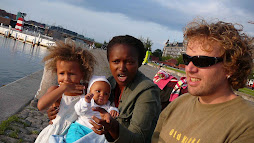
Though this blog was meant to be about my family's travels down the isles of the Caribbean, I lost the steam halfway and never completed the tale. I look at pictures and wonder about the people I met, what they are now doing. I was lucky enough to go sailing again in Trinidad, Grenada and the Grenadines around Christmas and New Year 2010. I met some of the people I have been wondering about. They are all fine and continuing with the business of living. How absolutely wonderful.
I was back in that familiar world, where I am perpetually a stranger looking from the sea onto the land and yet when I arrive on the land, I am content to be looking out at the sea. Grenada was as always amazing. We were welcome with huge smiles and hugs and everyone missed Ingrid. She made quite an impression on the islanders-they all sent their regards to her.
Trini was as it always is though the pomp of the petro dollar had faded with the dwindling money stocks in the world. But they were not fazed, the Trinis. At Christmas, they were preparing for the February Carnival. That's advanced planning!
The people of the grenadines were recovering from New Year's parties.
Thursday, 04 March 2010


Wednesday, 25 November 2009
Visa nightmares
Oh poor us with passports that no one seem to respect. Good thing I love my country, I at least can appreciate the irony of being refused entry in a country where you have no desire to live.
Dear dear Ingrid was subject to the most bizarre visa story. A saga developed as soon as we were told she needed a visa. It became even stranger when I tried to excricate an explaination for this refusal since I also possessed a South African passport. Oh, it's because you have an American visa in yours, I was summarily told. Now don't ask me to explain illogical ideas but safe to say that I failed to understand how my having a visa to a different country and thus getting entry into another one had any relation. I thought that was only reserved for the EU and the Commonwealth! We were turned back with stern warnings that Ingrid cannot go on land unaccompanied. A migration officer would be provided, at full charge of course, to escort her around. Her own private bodyguard in state uniform who has nothing to do all day but accompany an African woman as she looks at paintings, visits music stores and cafés. mh, this was deemed to be interesting.
Dear dear Ingrid was subject to the most bizarre visa story. A saga developed as soon as we were told she needed a visa. It became even stranger when I tried to excricate an explaination for this refusal since I also possessed a South African passport. Oh, it's because you have an American visa in yours, I was summarily told. Now don't ask me to explain illogical ideas but safe to say that I failed to understand how my having a visa to a different country and thus getting entry into another one had any relation. I thought that was only reserved for the EU and the Commonwealth! We were turned back with stern warnings that Ingrid cannot go on land unaccompanied. A migration officer would be provided, at full charge of course, to escort her around. Her own private bodyguard in state uniform who has nothing to do all day but accompany an African woman as she looks at paintings, visits music stores and cafés. mh, this was deemed to be interesting.
I am still around
I am jotting notes from this travel though I am nowhere close to finishing the travelogue for the voyage down island.
Bear with me and many notes will come your way.
ciao bella
p
Bear with me and many notes will come your way.
ciao bella
p
Thursday, 28 May 2009
Blog wins South African radio competition
Dear Friends
Just to brag a little and to thank my friend Linda who had the brilliant idea of entering our little adventure in a competition held by Radio 702 in SA. They liked the blog and the idea of travelling by sea with a family.
Thank you Linda.
Ocean Odyssey out
Just to brag a little and to thank my friend Linda who had the brilliant idea of entering our little adventure in a competition held by Radio 702 in SA. They liked the blog and the idea of travelling by sea with a family.
Thank you Linda.
Ocean Odyssey out
Thursday, 29 January 2009
Despacho, dismay and the laws of the land
We were welcomed with bravado to the Dominican Republic. It too exactly 2 minutes for the naval commander to spot us from wherever his vantage view was. As we made the final adjustments on the anchoring manouvre, a skiff with three men pulled along side, and a man in an interesting mixture of English and Spanish announced the arrival of the anticipated commander. They summarily jumped onto our boat, polite enough to ask if they could be allowed to keep their boots on, and requested boat papers. After filling in a long document in many duplicates, the commander via his non-english speaking second in commander who then looked at the translator, asked for a present. I laughed and I was reminded of the Congo. Cadeux. That word I had not heard in a year. Ha, welcome to the third world Pamela.
There was also a litany of papers waiting for us to be signed at the immigration, customs, agriculture, tourism and whatever else office the Dominicans could dream up. This was all starting to sound familiar. I swear, were it not for the Spanish, I would have thought I was in central Africa. IAs I was the one checking us in, I got my pen, all our papers, my charm and patience ready for the hours ahead. And the commander had made it clear that we could not wait longer, no time for another cup of coffee, he adamantly expressed. "You have to check in immediately," after which he departed our boat with a smiling translator who was trying to sell us a Dominican Marine Courtesy Flag. I doubt he, the translator, would get anything of the 'present'. Ergo, he had to push his own businness. As they say in South Africa, i-job yi-job. Viva la vida. I had my own job to do: filling out papers and getting through the authorities with non-existent Spanish.
There was also a litany of papers waiting for us to be signed at the immigration, customs, agriculture, tourism and whatever else office the Dominicans could dream up. This was all starting to sound familiar. I swear, were it not for the Spanish, I would have thought I was in central Africa. IAs I was the one checking us in, I got my pen, all our papers, my charm and patience ready for the hours ahead. And the commander had made it clear that we could not wait longer, no time for another cup of coffee, he adamantly expressed. "You have to check in immediately," after which he departed our boat with a smiling translator who was trying to sell us a Dominican Marine Courtesy Flag. I doubt he, the translator, would get anything of the 'present'. Ergo, he had to push his own businness. As they say in South Africa, i-job yi-job. Viva la vida. I had my own job to do: filling out papers and getting through the authorities with non-existent Spanish.
Thursday, 08 January 2009


Wednesday, 07 January 2009
Dominican Republic
Here we come
For me who had never been to a Spanish speaking place, I was delighted to have a chance to see the people of this island Hispaniola. Ingrid and I had been attempting hard at learning some useful Spanish which contained phrases about food, directions etc. The best we could come up with from our several lame tries was 'Animate' with an exaggerated Spanish accent which we thought would be useful to cheer up any reluctant customs officer. Mads left all the linguistical challenges to the female crew. Not to be outdone, we imagined that our African French tinged with a bit of slow Spanish would suffice. How wrong we were. We did not understand anything. NADA baby. Flagrant gestures and wide grins were the saviours of our days.
For me who had never been to a Spanish speaking place, I was delighted to have a chance to see the people of this island Hispaniola. Ingrid and I had been attempting hard at learning some useful Spanish which contained phrases about food, directions etc. The best we could come up with from our several lame tries was 'Animate' with an exaggerated Spanish accent which we thought would be useful to cheer up any reluctant customs officer. Mads left all the linguistical challenges to the female crew. Not to be outdone, we imagined that our African French tinged with a bit of slow Spanish would suffice. How wrong we were. We did not understand anything. NADA baby. Flagrant gestures and wide grins were the saviours of our days.

We had a pleasurable sail from Turks and Caicos due south to Luperon harbour on the north coast of the DR, the amber coast as it is sometimes called. By early morning we found ourselves some 10 miles west of Luperon. We had to quickly make it to the anchorage before the trade winds started piping in at 25 knots. We coasted along the beautiful landscape, which we had seen from a distance. It is an amazing trick to the eye when you set your eyes on DR from a distance. Coming from flat Bahamas and Turks and Caicos, it is awesome to see the towering mountains of this island. You are almost deceived and think that the island is closer that it is, only to realise you are still a good 30 miles out.

We made it into Luperon, a harbour in the mangroves, protected by reefs on each side. Here the water is very murky so we had to slowly make our progress into the western channel. There were more boats than we had anticipated and by the look of things it seemed we could not find any space to anchor. We were also weary to continue further down the channel as we knew there were shallow areas in the middle of the anchorage. We found one spot and decided we would return to it if there was nothing better further down the channel. Not clever. We got stuck in the mud. The depth went from 4 metres to 1 metre in a matter of seconds. We had thought we were quite clever and we could avoid running aground if we sailed really close to big boats. Ah well, that just shows you that you can't always trust your eyes especially when you cannot see the bottom. Though everyone was in the middle of breakfast, lots of dinghies came out to push us out of the mud. We were showered with friendly laughs and were told that we were the third boat to have fallen into the same triap that morning. That made us feel much better. You don't want to be the only clown in the circus.
Tuesday, 06 January 2009
A taste of the Turks and Caicos
Just to show how little fascination we had of the place, Ocean Odyssey's resident photographer, Ingrid, took only about 30 pictures of our entire visit in the Turks and Caicos. And this is a woman who is unstoppable when it comes to clicking on the camera.
 The famous slipper lobster caught outside of Ambergris. The day after Mads had speared it, when we were heading for the Dominican Republic, we spent three hairy hours zigzagging between coral heads in the bank before we could exit. Quel horreur. Sailors be aware of the waiting trap (and we are not the only ones to whom this has happened). This was by far the most harrowing sailing experience we had in the 14 months we sailed.
 Thyra thinking about boat tennis.

Commercial Harbour
 View of amazing mansions from the boat.
Into Provo, not quite
The two most interesting creatures we met in these islands were firstly a cockroach looking crayfish in the Ambergris anchorage. Some months later we found out the creature is called a Slipper Lobster. The second were the massive coral heads outside of Ambergris island. Those I have no immediate desire to encounter again.
When we laid anchor outside the commercial bay in the Providenciales Island (Provo), we had to check in at customs in another bay across the hill from our bay. After parking the dinghy next to some dodgy characters, we started asking the same dodgy persons to give us directions to customs, a bar and a supermarket (in that order). The customs office was a ten minute walk, the bar not findable and a mini market a bit of a distance. At the dusty entrance of the busy Provo harbour, we were duly informed that children are not allowed into the premises. Whilst the children and I were coughing dirt and chatting with the security guard who was more interested in his mobile phone than the trucks that were on business at the harbour, Ingrid and Mads went to check us in. Luckily it took a much shorter period than anticipated.
We had been informed that the minimarket was along the newly paved road. The area was a bit odd, a mixture of tropical paradise mansions next to huge building sites and no life to speak of. The minimarket was as exactly as I expected it; a few selected items on the shelves with gravely expensive tags on them.
Central town was far away and we could only get there by taxi and the fee was purpotedly expensive too. I was getting tired of hearing that word but then I realised that I am just a pompous boat owner who is looking for cheap ways to do things. The people there had to live with those prices, they could not exactly opt out. I for one could always pack up and sail away; which we did as soon as the weather was right. We heard mention of barbecues and all sorts of get togethers for sailors and travellers but I must admit, Provo did not quite charm us. Possibly the only charming element of our anchorage was the hotel on top of the hill, which obviously was ostentatious in its days. After checking out with customs, we took the path that cuts right across the hotel. At first we were sure that it was uninhabited and then as we found ourselves on the main ground, beautiful aromas were wafting across the parched lawn. The whiff was that of food. To our amazement, the place was full of Asian people. On the clothes lines were colourful silk clothes which brightened this erstwhile grand hotel with its magnificent views. We later found out that the Asian people were part of the construction and marine industries. Such are the demands of capitalism and the chase for a better life for one's children: these will move you worlds away from that you love most.
More blogging coming
I know I promised to tell the Caribbean tales. More is coming. There are stories from Turks and Caicos, Dominican Republic, Virgin Islands, St Kitts & Nevis, Antigua, Dominica, St Vincent and the Grenadines, Grenada and Trinidad and Tobago.
It should be good reading.
It should be good reading.
old goodies
LOOK WHAT I FOUND LYING IN THE OLD BLOG ON BLOG.CO.UK
Her lady Ocean Odyssey awaits guests
The dark burgundy Ocean Odyssey, a Moody 42 sailboat awaits to be traversed over blue waters and to be taken to far shores. The lady, as the American friend Peter calls her, ís resting in the western coast of Florida after we purchased her. The proud skipper, Mads, who spent a month rehaulling her and cleaning out every accessible dark corner from inside the hull is anxious to return to her. We are still in Denmark, scheduled to return to the lady at the end of July.Friends, check your calenders and start booking your visits with us. We anticipate that we will spend a couple of months in the lands of the Carib and the USA so feel free to join us anytime from August 2007.
Wednesday, 19 November 2008
Hello Turks and Caicos
I know that to many the name sounds vaguely familiar but one can't quite figure out where one has heard it before. In the Atlantic, just under 80 nautical miles south east of Mayaguana in the Bahamas lie the islands of this British Overseas Territory which boasts a population of approximately 30 000. The Turks and Caicos islands are very similar to the Bahamas; full of coral reefs, flat, semi-arid, a little short of fresh water and blessed with absolutely clear blue water. One of the longest coral reefs in the world is found along these islands.
Thursday, 13 November 2008
Bye Bye Bahamas

Jamaica Cay
Our second last stop in the Bahamas was the idyllic island of Jamaica Cay where we had a barbecue on the beach with miles and miles of golden sand and no one else around. Not even sandflies disturbed our precious evening meal.

The following day we left for Salina Point settlement, the most southern village on the island. We negotiated for five hours through shallow water dotted with menacing coral heads. At some point we had to take the sails down as the wind was piping up and it was becoming difficult to steer the boat with that much power on the sails. We motored the rest of the way through some treachorous areas in the bight of Acklins and then came out on the deep side and headed straight south.
At the entrance to the bight on the southern side, we were met by jumping dolphins who seriously looked like magical creatures in the orange afternoon light. I knew then how the references to mermaids originated. As we watched, the telephone rang and we were all taken aback as the Bahamian telephone network was a bit of a hit and run making it impossible to know when you would be able to receive or make phonecalls and that we had not used the phone for a month. It was Tshina calling from Denmark wishing Pam a happy birthday in advance.
We crawled our way through some more coral heads in an attempt to find a place to anchor. We tired to anchor twice and still no luck. The bottom being rock solid hard was not cooperating with us. In the end Mads snorkelled down to the third anchor spot and had to shift some sand for the anchor to settle a bit. We had, earlier with Liz and Paul, made jokes about American seamen who told stories of carrying shovels for digging holes for their anchors and had written them off as ridiculous and bored yachtsmen. Not that a shovel would have helped in this coralled bottom but it would have saved the skipper's arms from engaging in complex under water exercises for which no water aerobics class can ever prepare you.

We settled for the night and watched the fishermen's boats rolling in the shallow waters.
Salina Point Settlement
Bye Baha Mar
Mission water collection was on the programme. Ingrid, Thyra, Fika and I left the skipper to go and forage in the neighbourhood. This time it would take a dinghy ride, a 3km walk with four jerry cans to get to the settlement. It seemed that Saturdays were reserved laundry day. All the young girls, whom we asked for directions, were engrossed in the weekly washing of school uniforms and Sunday school dresses. Salina point is located on the eastern side of the island facing the Atlantic which pounds the rocks everyday making the sea look menacing. The village has everything the inhabitants require: mobile phone connection, desalination plant, school, clinic, church and also amazingly 3 restaurants and a small hotel.
We were even escorted to the general store where we could purchase frozen food and canned goods. The proprietor, a very friendly man with a warm laugh, drove us to the public tap, filled our jerry cans and drove us back to the harbour. His children were then asked to load our dinghy and help push us it out as the tide was low by the time we returned.
The captain was pleased to see his crew return. We prepared the boat for departure. We were all a bit subdued as this was our last anchorage in the Bahamas.
At four o'clock on March 23rd 2008 we picked up and waved goodbye to Acklins island. We were aiming for Turks and Caicos, some 160 nautical miles south east of Acklins island. Typically the wind was not cooperating with us as it came straight from the south of east. As we rounded off Castle Island, we decided to make a straight course towards Turks and Caicos and then tack up north. As it were, we tacked up north and the skipper realised that the best option would be to sail all the way up to Mayaguana's north coast and hope that the wind woud shift east so we could make a straight southerly run for T& C. On the second afternoon we spotted Mayaguana and waved and waved. This would be the last island we would see in the Bahamas.
Bye Baha Mar
As we chatted about leaving this beautiful desert in the Atlantic, the fishing rod suddenly started coming to life. Mads got very busy in the next half-hour. We could see that we caught a dorado, the most delicious fish on the planet. As Mads reeled it in, we could see all its fantastic colours and children and adults were clapping like mad in anticipation of a feast. Then the rod just bucked over forward and silence. Lo, the fish was gone. We thought it had managed to untangle itself. But what were we seeing behind the boat. A ginormous shark of some sort. We ran downstairs to check in the marine book. It turned out that it was the rare Atlantic white tip ocean shark. The fellow was quite pleased with our catch and it stayed with us for an hour just behind the boat. We were determined that we were not going to fish for it, so the fishing rod stayed put. We sailed on towards the east coast of Mayaguana during the evening and by midnight we were well out of Bahamian water.
Our exit was dramatic, exquisite and expressed our true sentiments about the Bahamas. We would never forget the warm friendly people who prize their conch and rice and peas above all dishes. We would remember their national pride and resilience in this blue water desert of the Atlantic. We respect them for making themselves into what they today are; from slavery into a thriving people who love their children, their homecoming meetings and their regattas.
What is a Sapodilla?
Now some of you might be wondering what in the world I am talking about, mentioning strange fruits that are not a common sight in world supermarkets. Well in the Bahamas and the rest of the Caribbean, this very tasty fruit is part of the daily diet (in season of course). It resembles a kiwi but tastes like a mixture between a pear and a mango. If you ever find one, enjoy.
Friday, 19 September 2008
Campari and Sapadillas
 Ivan, the owner of a resort on Delectable Bay (I am not making it up), who took us for a Sapodilla hunt through the bushes.
 Next to an old cemetery, we met two people hacking away into some bark, which turned out to be the main ingredient in Campari.
Blue holes and crabs in Acklins
 Meet the two eccentric Brits, Liz and Paul the hardy sailors, though not too hard on themselves, from Wales who enjoy the ocean and their home with the equally mad horse named Alex whose favourite hobbies amongst others include eating from the fruit bowl and switching on lights. Alex and Liz convinced Mads one night to venture out for some nocturnal fishing from the enormous blue holes in the bay. These holes are known to run through from the islands' bank side in the west to the ocean side in the east. Apparently Jacque Costeau, the mad frenchman, in an experiment to determine the length of the blue holes poured dye in one and watched from the helicopter a couple of hours later the dyed water coming out far on the ocean side. I do not quite remember the precise distance but it was over 5km outside the eastern shore.
As Mads could certainly not miss the opportunity for fishing: he and Ingrid had tried for a solid hour, earlier during the day where the fish proved to be too big. Mads had also been swimming in the swirling bathtub and spotted 6 sleeping sharks, large fish, crabs so he was very excited to catch some crab.
However delightfully easy it may sound when a salesman tells you a crabtrap is the best way to catch crabs, don't believe them. It proved toughgoing and all the bait was just eaten clean by the time they pulled the trap up. So came Paul with the brilliant idea of jumping in with slings to spear hunt the crabs amid loud protests from Liz who was not impressed by her intrepid crazy man whose source of thrill that night was to be derived from diving, in the dark, into a huge circular hole with swirls and strong current. In the end, they jumped in.

Needless to say we had crab for dinner the following day. Ai Ai Skipper.

I wonder what the manufacturer was thinking. It is good chocolate at least.
Wednesday, 10 September 2008
Spring Point Settlement
 Coby, once a bodyguard of a former Prime Minister, has a bar and cafe on the main road of Acklins which goes through Spring Point where he serves amongst other interesting things'pig's feet sauce'. Sauce is pronounced with a very strong southern Bahamian accent and sounds more like 'soous'. Apparently Chinese aphrodisiacs are also available at the bar. At Coby's bar, the local workforce; fishermen, waterworks people, road workers, stops for a midday Kalik, pig's feet and Coby's fresh baked bread.
 An ancient cottage in Acklins- there are many of these abandoned houses around. Two thirds of the 300 000 strong Bahamian population lives in Nassau therefore many islands are quite empty.
 One of Coby's goats. We could not have this one for lunch though.
The life on Acklins
 What can we say. We have seen many beautiful sunsets and they are never quite the same. Optical illusion? Maybe. This particular sunset was viewed on Long Cay after a very appetising day- goats on offer, fish and lobster galore and not to mention the interesting population of Albert Town. The total number of the population kept changing with each person we asked. The first reported 19, the second 21 and the third 23. So we will stick with the latter. Even small settlements can feel very big (it is demanding work to make a census) and this former capital of the Bahamas felt indeed like that.
 And we say hurrah to that.
 We non-chalantly walked past this house and commended the workers for doing a great job restoring it. We were also secretly proud that someone has put his/her money to renovate this old cottage only to be told "oh no, no one is going to live here. At least no one living. This is going to be a mortuary" . Oh well, at least the departed will rest well. It turns out that the islands have no facilities and they have to transport bodies to Nassau for embalming before they are sent back to the island again.
ACKLINS and CROOKED Islands
From Rum our next destination was Mayaguana island lying south east of Rum and one of the truly remote islands of the Bahamas. At Rum we had been waiting for a north easterly wind which typically arrived much later that it was forecast and at that came at night when everyone had gone to bed swearing at meteorologists and the unpredictability of the wind. It was thus that we ended in Acklins; the wind was blowing a steady 15 knots from the east and we were making very good speed and not to mention that we were not heading straight into the sea. BEAM SEAS, who has ever heard of such a concept when sailing from the USA to the Caribbean. We took such a pleasure from the sail that we went through several dishes for dinner. Then the wind changed and in our recently acquired pleasure of comfortable sailing, we refused to give this precious commodity up and instead of sailing straight into Mayaguana, ergo, the waves, we changed course and decided to visit Acklins and Crooked Islands. And what a great discovery it was.
Long Cay
As luck would have it, sometimes it comes in abundance, we continued sailing due south and arrived too early at the entrance to the bight of Acklins. The captain heaved the boat to and waited for first light. After dawn coffee, we sailed into the shallow bight slowly doglegging around the green water, a very unsettling issue since one is used to the crystal clear water in the majority of islands. As we were about to find a good anchor spot, an enormous barracuda leapt out of the water and onto our hook. We discarded it for fear of ciguatera only to be told later that the stock in the area is perfectly safe to eat. A couple of hours of rest for the exhausted crew after a hearty breakfast was on the cards.
As luck would have it, sometimes it comes in abundance, we continued sailing due south and arrived too early at the entrance to the bight of Acklins. The captain heaved the boat to and waited for first light. After dawn coffee, we sailed into the shallow bight slowly doglegging around the green water, a very unsettling issue since one is used to the crystal clear water in the majority of islands. As we were about to find a good anchor spot, an enormous barracuda leapt out of the water and onto our hook. We discarded it for fear of ciguatera only to be told later that the stock in the area is perfectly safe to eat. A couple of hours of rest for the exhausted crew after a hearty breakfast was on the cards.
In the afternoon we dinghied over to the far lying docks in search of Albert town which lies on the opposite shore of the island. With the baking sun directly over our heads we made slow progress up the hills amidst numerous wandering goat herds. Close to the village we met a man skinning a goat and when we enquired about the roaming goats, he told us we could eat goat for dinner if we wanted to with the only provision being hunting one. It turns out that the goats are wild and with no natural predators the numbers have proliferated. I suppose it is less exerting to dive for conch than to spend your day with a dodgy hunting rifle in a scorcher hunting goat amidst thorny acacia trees.
Albert town is small picturesque settlement dotted with bright and luminious walls . At the centre is an old wooden church that sort of serves as a tourist attraction to the village. Judging by the response of Officer Wright, who overzealously enquired about our mission and religiously took all our details only to be miffed that we were not carrying our passports; one has to conclude that there cannot be that many tourists in the village.
From Georgetown to Crooked-Acklins Islands
 Conception mangroves
 Ingrid playing with the camera
 the shark that got away with our fish
After spending too long a time in Georgetown, the chicken harbour amongst sailors, we had had enough and decided to start moving eastwards towars Conception and the rest of the east lying islands in the Bahamas.
At Conception, we were met by incredible beauty, unsurpussed if I have to say it myself. This is an uninhabited island of exceptional spleandour consisting of natural bays, corals and mangroves. On our second day there, whilst snorkelling with Mads, it was brought to my attention that a huge shark was just swimming past. Very close encounter indeed at about 10 metres away. In trepidation I looked at Mads for support, who then told me in sign language to just relax and sure enough the shark was gone after five minutes. We identified it as the White Tip which is not known for aggression, but hey, a shark is shark no matter what anyone tells you. Remember Jaws! OK, we know Steven S spoiled it for the shark population, not exactly good PR for the species.
At Conception, we were met by incredible beauty, unsurpussed if I have to say it myself. This is an uninhabited island of exceptional spleandour consisting of natural bays, corals and mangroves. On our second day there, whilst snorkelling with Mads, it was brought to my attention that a huge shark was just swimming past. Very close encounter indeed at about 10 metres away. In trepidation I looked at Mads for support, who then told me in sign language to just relax and sure enough the shark was gone after five minutes. We identified it as the White Tip which is not known for aggression, but hey, a shark is shark no matter what anyone tells you. Remember Jaws! OK, we know Steven S spoiled it for the shark population, not exactly good PR for the species.
We spent a couple of days at Conception (mangroves with clear water, turtles, more sharks) and left for Rum Cay some 20 miles south east of the island. We departed too late as we were entranced by the mangroves which then meant a late entrance at Rum which is literally covered in corals. We made it to the anchorage without much drama except our elevated heart beats. We swear not to do it again.
Subscribe to:
Posts (Atom)